Jumbo Rates for $1.2M Austin Homes in 2026

CEO & Founder of Chestnut Mortgage. NMLS #2687968. · May 7, 2026

For Austin buyers seeking $1.2 million homes, jumbo mortgage rates have improved significantly heading into mid-2026. Chestnut Mortgage is quoting 5.605% (5.645% APR) for well-qualified borrowers, while major banks range from 5.875% (Citi) to 6.473% (Bank of America). With Texas’s conforming loan limit at $832,750 for single-family homes, most purchases at this price point require jumbo financing unless buyers bring substantial down payments exceeding 33%.
At a Glance
-
Competitive jumbo rates start at 5.605% (Chestnut Mortgage), with major banks ranging from 5.875% to 6.473%
-
Austin’s major banks typically quote at the higher end: Chase at 6.000%, Wells Fargo at 6.275%, and Bank of America at 6.473%
-
Minimum requirements include 680+ credit score, 10-20% down payment, and 6-12 months of mortgage payments in reserves
-
Shopping five lenders can save approximately $3,000 or more over the loan lifetime
-
Non-bank lenders and AI-powered platforms often beat traditional bank quotes by 0.25-0.50 percentage points
Purchasing a $1.2 million home in Austin means navigating the jumbo mortgage landscape, where competitive lenders now offer rates in the mid-to-upper 5% range while Austin’s major banks still quote closer to 6% or above. With the spread between best and worst quotes exceeding 0.85 percentage points, understanding how to secure competitive financing has become crucial for Austin homebuyers entering the luxury market.
2026 jumbo mortgage rates in Austin at a glance
As of May 2026, jumbo mortgage rates have improved meaningfully from 2025 levels. Chestnut Mortgage leads at 5.605% (5.645% APR), while major banks quote higher: Citi at 5.875%, US Bank at 5.976%, Chase at 6.000%, and Wells Fargo at 6.275%. For Austin specifically, buyers approaching traditional banks should expect quotes in the 6.0%-6.5% range, while non-bank and AI-powered lenders can deliver sub-6% terms.
The term “jumbo loan” refers to any mortgage exceeding conforming loan limits set by the Federal Housing Finance Agency. While these loans once carried significantly higher rates than conforming mortgages, the gap has narrowed considerably. Today’s jumbo borrowers face a more competitive landscape, though securing the best rates still requires strategic shopping and strong financial credentials.
Looking ahead through 2026, market conditions suggest continued rate improvement. Federal Reserve policy decisions and broader economic indicators will influence rate movements, making lender selection increasingly important for Austin’s luxury homebuyers.
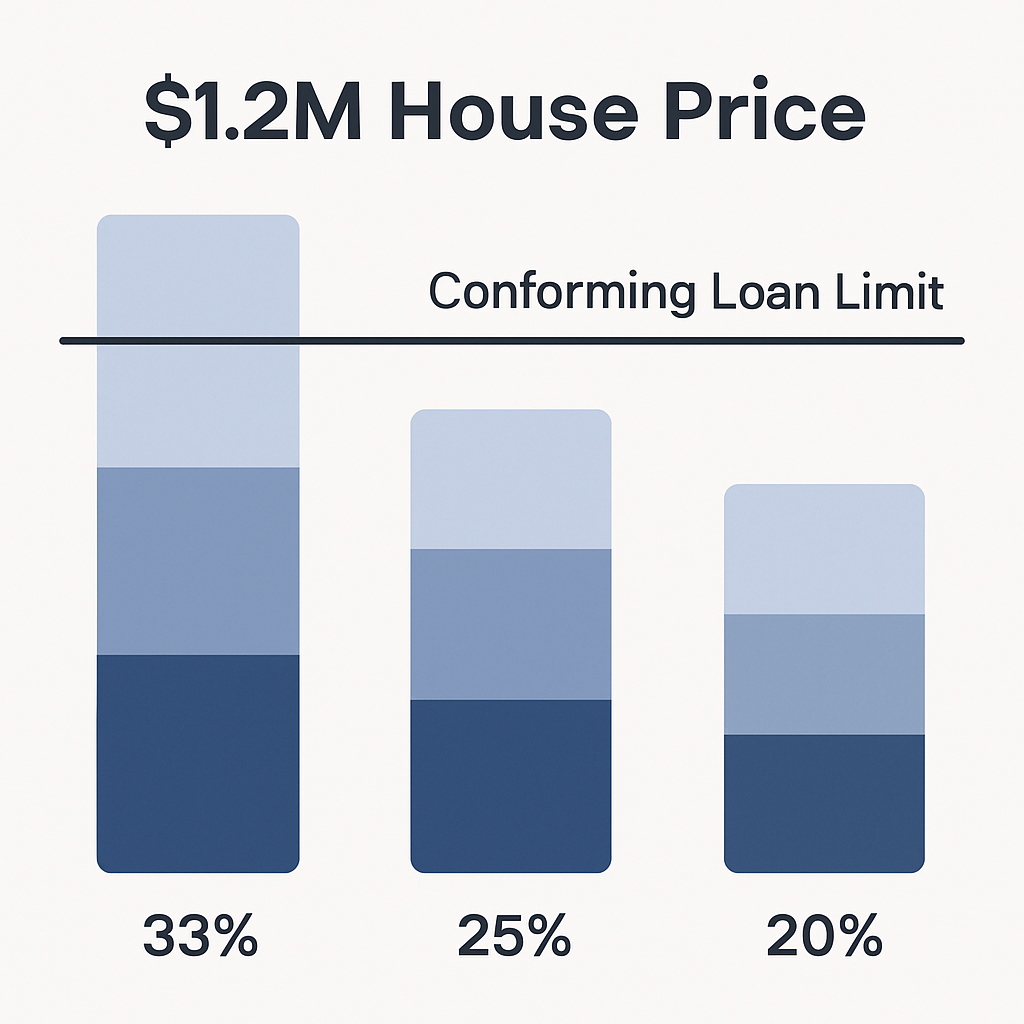
Is a $1.2 million Austin purchase automatically a jumbo loan?
Not necessarily. The answer depends on your down payment amount and Travis County’s conforming loan limits. The 2025 limit stands at $806,500 for single-family homes throughout Texas, including Austin. This means a $1.2 million purchase with a 33% down payment ($396,000) would keep your loan amount at exactly $804,000 - just under the conforming threshold.
However, most buyers putting less than one-third down will cross into jumbo territory. A traditional 20% down payment on a $1.2 million home results in a $960,000 loan, clearly exceeding conforming limits. Even with 25% down, you’d still need a $900,000 mortgage.
Texas maintains uniform conforming limits across all counties, unlike California or New York where high-cost area adjustments apply. Harris County follows the same $806,500 threshold as Travis County, keeping consistency across Texas’s major metropolitan areas.
Key takeaway: Unless you’re bringing substantial cash to closing, that $1.2 million Austin property will likely require jumbo financing.
See your rate in 2 minutes
No phone calls. No credit check. Compare options from 100+ lenders.
Email ChestnutHow current jumbo APRs stack up: national averages vs. Austin’s big banks
The jumbo mortgage rate landscape reveals significant disparities between national averages and what Austin’s major banks actually quote. Here’s the current snapshot:
| Rate Type | Best Available (May 2026) | Austin Bank Range | Spread |
|---|---|---|---|
| 30-Year Fixed Jumbo | 5.605% (Chestnut Mortgage) | 5.875% - 6.473% | +0.27% to +0.87% |
| Major Bank Range | Citi 5.875% | Chase 6.000% - BofA 6.473% | Varies by bank |
| Portfolio Loan Premium | Base rate | +0.25 to 0.75 points | Bank-held premium |
Large financial institutions consistently price at the upper end of these ranges. Wells Fargo quotes 6.275%, Bank of America 6.473%, and Mutual of Omaha 6.740%. This pricing reflects their portfolio lending model, where loans remain on bank balance sheets rather than being sold to secondary markets.
Austin borrowers frequently encounter quotes 40 to 85 basis points higher from major banks compared to AI-driven platforms like Chestnut Mortgage. This premium particularly impacts borrowers who default to their existing banking relationships without comparing alternatives.
Why big banks quote higher jumbo rates — and who’s filling the gap
The structural reasons behind inflated bank pricing stem from how these institutions handle jumbo loans. Many banks keep jumbos as portfolio loans, tying up capital that could otherwise generate returns through other lending activities. This capital constraint, combined with heightened regulatory requirements following 2023’s regional banking turmoil, drives banks to price defensively.
Meanwhile, the mortgage landscape has shifted dramatically. Independent mortgage companies now originate nearly 70% of purchase loans, up from 62.1% in 2020. These non-bank lenders operate with different economics - they sell loans rather than holding them, enabling more aggressive pricing to win market share.
“Jumbo mortgages don’t get sold to Fannie or Freddie,” notes Melissa Cohn, regional vice president of William Raveis Mortgage. “Many of them are portfolio loans”, meaning banks shoulder the full risk rather than distributing it through securitization. This risk retention translates directly into higher rates for borrowers who stick with traditional banking channels.
The gap creates opportunities for borrowers willing to explore beyond their primary bank. Non-bank lenders, credit unions, and fintech platforms increasingly compete for jumbo business with rates closer to national averages.
How Austin buyers can lock a lower jumbo APR in 2026
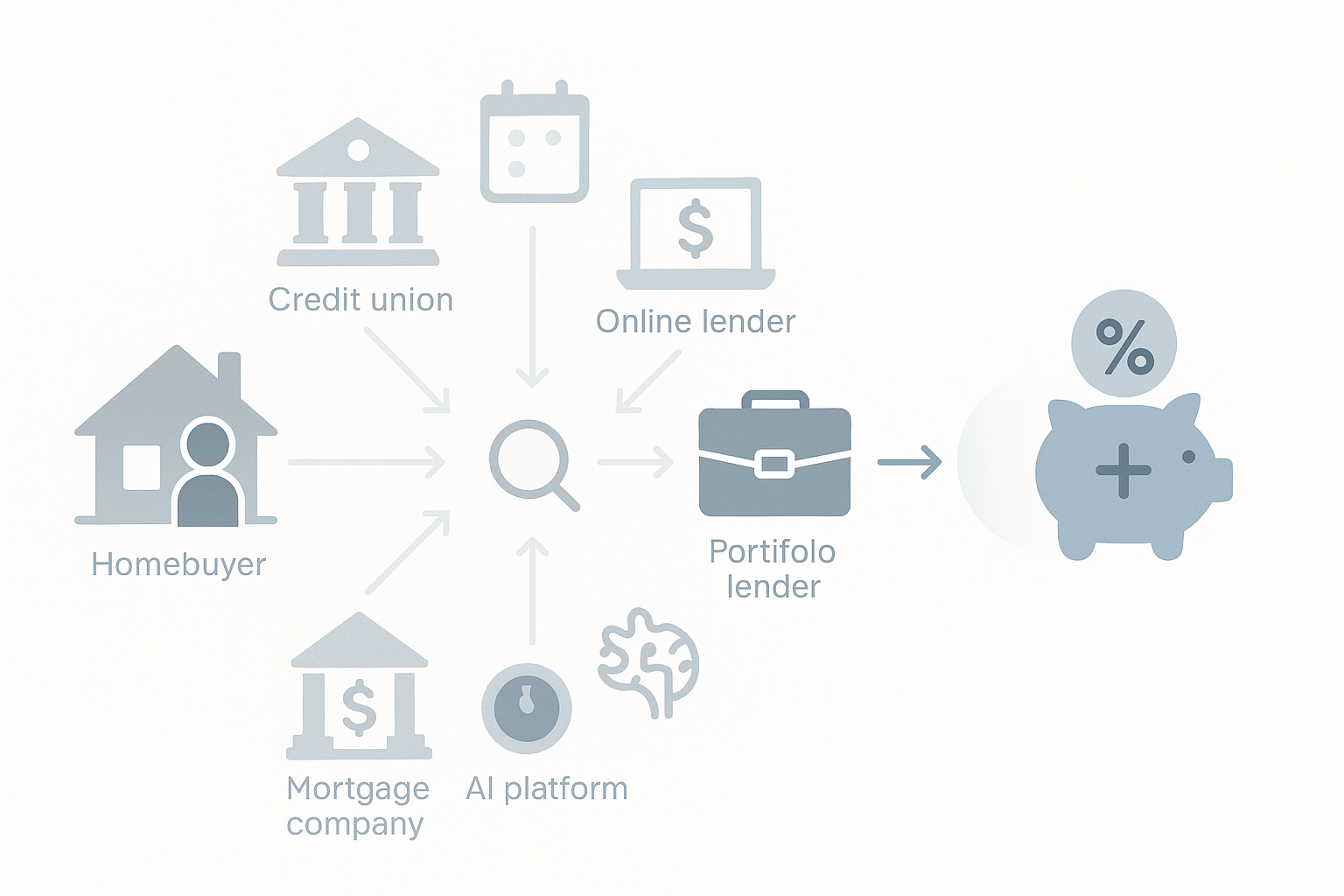
Securing competitive jumbo rates requires a systematic approach that goes beyond accepting your bank’s first offer. Start by pulling quotes from at least five different lender types:
- Regional credit unions (often member-restricted but worth joining)
- Independent mortgage companies
- Online-first lenders
- Portfolio lenders specializing in jumbo products
- AI-powered platforms that aggregate multiple offers
Timing matters significantly. Rate shopping saves $1,500 or more with just one additional quote, while comparing five lenders typically saves $3,000 or more over the loan’s lifetime. For a $960,000 jumbo loan, even a 0.25% rate reduction saves approximately $145 monthly — nearly $52,000 over 30 years.
Consider these strategic moves:
- Lock when the 10-year Treasury dips below 4.3%
- Explore 15-year terms if cash flow permits
- Negotiate lender credits to offset closing costs
- Bundle banking relationships for relationship pricing
- Use AI comparison tools to access wholesale rates
The most successful borrowers treat rate shopping like negotiating a car purchase - never accepting the sticker price and always maintaining multiple options until closing.
Chestnut AI™ vs. manual rate shopping
Chestnut’s proprietary AI technology fundamentally changes how borrowers access competitive jumbo rates. Rather than manually contacting individual lenders, the platform instantly analyzes options across more than 100 lending sources, consistently delivering rates approximately 0.50 percentage points below market averages.
The technology advantage shows in the numbers. AI-based underwriting reduces processing time from the typical 30-45 days to just eight minutes. “Borrowers using Chestnut AI™ typically see rate savings of 0.5% or more compared to traditional shopping methods,” with instant quotes in under two minutes rather than days of phone calls and paperwork.
This efficiency particularly benefits jumbo borrowers, who often face more complex underwriting requirements. The AI system identifies lenders with specific appetites for high-value Austin properties, matching borrower profiles to optimal lending programs that manual searches might miss.
Eligibility checklist for a $1.2 M jumbo loan in Texas
Qualifying for a jumbo mortgage requires meeting stricter standards than conforming loans. Here’s what Texas lenders typically require:
Credit Score Requirements:
- Minimum 680 for most programs
- 700+ for best rates
- 740+ for maximum loan amounts
Down Payment Thresholds:
- Standard requirement: 20% ($240,000)
- Some programs accept 10% with higher credit scores
- 5% options available up to $1.5M with 680+ credit
Debt-to-Income Limits:
- Maximum 45% DTI for most lenders
- Some flexibility with compensating factors
- Lower ratios improve rate pricing
Cash Reserves:
- 6-12 months of mortgage payments in liquid assets
- Higher reserves for investment properties
- Retirement accounts typically count at 70% value
Documentation Requirements:
- Two years of tax returns for all borrowers
- W-2s or 1099s for income verification
- Complete asset statements
- Self-employed need business financials
Texas-specific programs offer some flexibility. New 2025 options allow 5% down on jumbos up to $1.5 million with 680 credit scores, expanding access for qualified buyers with less cash on hand.
How rate volatility and the lock-in effect shape Austin prices
The mortgage rate environment profoundly impacts Austin’s luxury housing market through what economists call the “lock-in effect.” Research shows each percentage point increase in the rate differential between current markets and existing mortgages reduces home sale probability by 18.1%.
This dynamic has real consequences. The lock-in effect drove home prices up 7.0% while simultaneously reducing transaction volume by an estimated 1.72 million sales nationally from 2022 to 2024. Austin’s high-end market feels this acutely — owners with sub-4% mortgages from 2020-2021 have been slow to sell even as rates have improved to the mid-5% range.
For buyers, the improving rate environment is creating new opportunities. A $1.2 million home financed at 5.605% (Chestnut’s current rate) costs roughly $800 less monthly than the same purchase at 6.5% — a meaningful improvement for Austin’s luxury market.
The rate compression between lenders adds urgency to comparison shopping. With Chestnut at 5.605% and Bank of America at 6.473%, the spread of 0.87 percentage points translates to over $500 monthly on a $960,000 loan — more than $180,000 over 30 years.
Key takeaways for Austin jumbo borrowers in 2026
Austin’s $1.2 million home buyers face a more favorable jumbo mortgage landscape than any point since 2022. While major banks still quote in the 6.0%-6.5% range, AI-driven platforms like Chestnut Mortgage are delivering rates as low as 5.605% (5.645% APR).
The most important actions for securing competitive jumbo financing:
- Compare at least five lenders including non-bank options
- Prepare strong financials with 680+ credit and 20% down
- Time your application strategically with market conditions
- Consider AI-powered platforms that aggregate wholesale rates
Chestnut’s technology has proven particularly effective, consistently delivering approximately 0.50 percentage points below market averages through its network of over 100 lenders. For a $960,000 jumbo loan, the difference between Chestnut’s 5.605% and a typical bank quote of 6.275% (Wells Fargo) translates to roughly $400 monthly savings — over $144,000 across the loan’s lifetime.
As 2026 progresses, the gap between bank-quoted rates and competitive market rates will likely persist. Austin buyers who treat jumbo financing as a competitive marketplace rather than accepting their bank’s first offer position themselves to save tens of thousands over their loan term. The tools exist to beat inflated bank rates — success comes down to using them strategically.
More Austin mortgage guides
- Best Mortgage Rates in Austin TX
- Austin Mortgage Rate Snapshot (May 2026): 30-Year Fixed, FHA & 5/1 ARM Options for First-Time Buyers
- Self-employed mortgage rates in Austin: Chestnut AI vs banks (2025)
- Rate-Lock or Float? Tactical Mortgage-Rate Plays for Austin Buyers Entering Q2 2026
Frequently Asked Questions
What is the current best rate for jumbo mortgages?
As of May 2026, the most competitive jumbo mortgage rate is 5.605% (5.645% APR) from Chestnut Mortgage, while major banks range from 5.875% (Citi) to 6.473% (Bank of America).
How do Austin’s jumbo mortgage rates compare to the best available?
Austin’s major banks often quote jumbo mortgage rates between 6.0% and 6.5%, while AI-driven platforms like Chestnut Mortgage deliver rates as low as 5.605%.
What factors influence jumbo mortgage rates in Austin?
Jumbo mortgage rates in Austin are influenced by Federal Reserve policies, economic indicators, and the lending practices of major banks, which often price at the higher end due to portfolio lending models.
How can Austin homebuyers secure lower jumbo mortgage rates?
Austin homebuyers can secure lower jumbo rates by comparing quotes from at least five different lenders, including non-bank options, and using AI-powered platforms like Chestnut to access competitive rates.
What are the eligibility requirements for a jumbo loan in Texas?
To qualify for a jumbo loan in Texas, borrowers typically need a minimum credit score of 680, a 20% down payment, a maximum 45% debt-to-income ratio, and 6-12 months of cash reserves.
How does Chestnut’s AI technology benefit jumbo mortgage borrowers?
Chestnut’s AI technology provides borrowers with instant quotes from over 100 lenders, often delivering rates approximately 0.50 percentage points below market averages, significantly reducing borrowing costs.
Sources
- https://www.bankrate.com/mortgages/jumbo-loan-rates/
- https://experian.com/blogs/ask-experian/jumbo-loan-limits
- https://cnet.com/personal-finance/compare-jumbo-mortgage-rates
- /news/chestnut-ai-engine-saves-home-buyers-0-5-percent-mortgage-rates
- https://www.usdamortgagesource.com/blog/texas-jumbo-home-financing-updates/
- https://www.fhamortgagesource.com/understanding-jumbo-home-loans-in-houston-2025-edition/
- https://www.investopedia.com/the-best-jumbo-mortgage-rates-11733500
- https://money.usnews.com/loans/rates/mortgages/jumbo-mortgage
- https://www.housingwire.com/articles/the-jumbo-market-is-up-for-grabs-part-ii/
- https://www.ncrc.org/mortgage-market-report-series-part-5-top-50-home-purchase-lenders-analysis-for-2024/
- /news/chestnut-ai-delivers-0-50-point-rate-advantage-2025
- /news/how-chestnut-ai-can-cut-your-rate-in-a-rising-rate-market
- https://defymortgage.com/learn/jumbo-mortgage-rates-texas/
- https://papers.ssrn.com/sol3/papers.cfm?abstract_id=5199409
- https://www.financialresearch.gov/working-papers/files/OFRwp-25-02_house-prices-debt-burdens-and-the-heterogeneous-effects-of-mortgage-rate-shocks.pdf
Sources
Data and statistics referenced in this article are sourced from public mortgage industry reports and Chestnut's internal analysis.

Ready to find
your best rate?
Our automated quote flow is paused. Email contact@chestnutmortgage.com and the Chestnut team will help directly.